A consumer uses a credit score in 8 steps: choose a score source, match personal identifiers to the bureau file, pull the 3 credit reports, read the complete score record, compare the score with the lender channel, dispute file errors before applying, group applications inside 1 rate-shopping window, and recheck the score on a monthly cycle. The workflow rests on 3 requirements: a scorable credit file, 4 identity data points for file matching, and consent for each application pull. A consumer below the scorable-file threshold receives a no-score response instead of a number, and the eligibility rules for that state sit on the requirements page of this cluster (internal link: Credit score, “What are the requirements and eligibility rules for credit score?”). The mechanism behind every step — furnisher reporting, bureau storage, pull-time calculation — sits on the mechanism page (internal link: Credit score, “How does a credit score work?”).
What does a consumer require before using a credit score?
A consumer requires 3 things before using a credit score: a scorable file, matching identity data, and a permissible purpose for each pull. FICO sets the scorable-file criteria in FICO documentation: at least 1 account open for 6 months or longer, at least 1 account reported within the past 6 months, and no deceased indicator on the file. VantageScore 3.0 and 4.0 score a file with 1 account, including an account younger than 6 months, per VantageScore Solutions documentation, so a thin file produces a VantageScore and a no-score response from FICO in the same week. File matching uses 4 identity data points: full name, current address, date of birth, and Social Security number in full or partial form; a mismatch routes data into a mixed file and corrupts every later step. Each application pull requires a permissible purpose under the Fair Credit Reporting Act, and the applicant’s written or electronic application supplies the consent for a hard inquiry.
The 3 requirements divide by owner. The consumer controls the identity data and the consent. The furnishers and bureaus control the scorable file, because reporting is voluntary and runs on furnisher calendars. A consumer with no reported account in the past 6 months holds a stale file, and the Consumer Financial Protection Bureau counted 19 million adults with insufficient or stale records in 2015 — the workflow below starts only after the file produces a score.
What are the 8 steps for using a credit score?
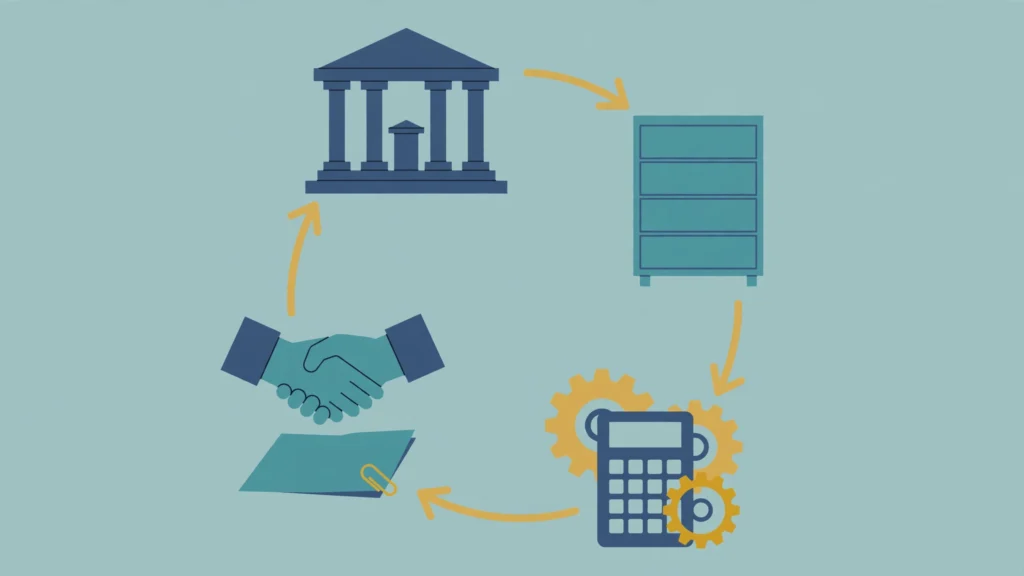
The 8 steps for using a credit score run in a fixed order, and each step consumes the output of the step before it.
- Choose a score source. Free routes come first: a bank or card account in the FICO Score Open Access program (more than 250 million accounts, per FICO), a bureau free tier, Credit Karma, or the myFICO Free plan. A mortgage preparation adds the paid mortgage score versions, because free tiers omit the classic mortgage versions (internal link: F0394, “What are the costs, fees, and rates of credit score?”).
- Match personal identifiers to the bureau file. Enter the full legal name, current address, date of birth, and Social Security number exactly as furnishers report them. A former address or a suffix difference (Jr., Sr.) splits a file or merges a relative’s account into it.
- Pull the 3 credit reports. AnnualCreditReport.com delivers the Equifax, Experian, and TransUnion reports free on a weekly online schedule since 2023. The reports are the input layer: the score prices the report, so the report check precedes every score reading.
- Read the complete score record. A score record holds 6 fields: the number, the model, the version, the bureau file, the pull date, and the scale. Lenders also receive up to 4 or 5 reason codes naming the top factors lowering the score, such as a high utilization ratio; the Credit Utilization Calculator converts balances and limits into the utilization figure behind that code (internal link: R04-C01, “Credit Utilization Calculator”).
- Compare the score with the lender channel. Each channel pulls a different model and version, per the channel table in the next section. A consumer score on Experian data with FICO Score 8 prepares a card application and misleads a mortgage preparation, where the classic tri-merge versions rule in 2026.
- Dispute file errors before applying. FCRA Section 611 gives the bureau 30 days to investigate a dispute, plus a 15-day extension in defined cases. A dispute filed 60 days before an application lets the corrected file feed the lender pull; a dispute filed after the pull prices the loan on the erroneous file.
- Group applications inside 1 rate-shopping window. FICO counts mortgage, auto, and student loan inquiries inside 1 window as 1 inquiry: 45 days in newer FICO versions and 14 days in older versions, per FICO documentation. VantageScore groups inquiries in a rolling 14-day window across all credit types. Applications for the same loan type therefore cluster into the shortest window the channel’s model allows.
- Recheck the score on a monthly cycle. Free tiers refresh on a monthly or 30-day cycle, and a fresh report pull precedes each major application. After a decision, the adverse action and risk-based pricing notices under FCRA Section 615 disclose the exact score the lender used, with the range, the key factors, the date, and the bureau, as amended by Section 1100F of the Dodd-Frank Act of 2010 — the notice closes the loop by revealing the channel’s real number.
Which score does each lender channel pull?
Each lender channel pulls a distinct score set: mortgage lending pulls a 3-bureau tri-merge of classic FICO versions, auto lending pulls an industry score or a general score from 1 bureau, card issuers pull a bankcard or general score, and landlords pull a screening product. The table states the channel, the score set, and the bureau basis; score types and versions in depth sit on the types page of this cluster (internal link: F0393, “What are the types of credit score?”).
The channel table includes 5 channels and separates lending channels from screening and display channels.
| Channel | Score pulled | Bureau basis |
|---|---|---|
| Mortgage (Fannie Mae / Freddie Mac delivery) | Classic FICO Score 2, 4, and 5 tri-merge in 2026; FICO 10T and VantageScore 4.0 validated by the FHFA in October 2022 | 3 bureaus, 3 scores, 1 representative score selected under lender guidelines |
| Auto lending | FICO Auto Score or VantageScore, lender’s choice | Usually 1 bureau file |
| Credit card | FICO Bankcard Score, FICO Score 8, or VantageScore | Usually 1 bureau file |
| Rental screening | ResidentScore or a bureau screening report (TransUnion SmartMove and equivalents) | 1 bureau file, applicant consent |
| Consumer display | FICO Score 8 or VantageScore 3.0 in apps and bank accounts | 1 or 2 bureau files, educational purpose |
The pattern after the table is bureau count. Mortgage lending is the only mainstream channel that buys all 3 files, because Fannie Mae and Freddie Mac delivery rules standardize the tri-merge; every other channel buys 1 file and accepts the file-difference risk described in the mechanism page. A consumer therefore checks the Experian-based score for a card application and the full 3-file set before a mortgage application.
How does a mortgage applicant use a credit score? (Illustrative example)

The example is illustrative: a first-time buyer runs the 8 steps across 90 days before a mortgage application, and the dates are a hypothetical schedule, not a lender requirement. On day −90 the buyer completes steps 1 to 4: a paid myFICO plan supplies the classic mortgage versions, the buyer pulls the 3 reports, and the score record shows the model, the version, and the bureau for each file. On day −75 the buyer finds a 60-day late payment from a closed card on the TransUnion file and files a Section 611 dispute (step 6, moved earlier because the 30-day investigation period sets the timeline). On day −40 the bureau corrects the file. On days −14 to 0 the buyer applies at 3 lenders inside a 14-day window (step 7), so the mortgage inquiries count as 1 inquiry under both the 14-day and 45-day window rules. Each lender pulls the tri-merge (step 5), and the corrected file feeds every pull.
How does a car buyer use a credit score? (Illustrative example)
The example is illustrative: a car buyer compresses the 8 steps into 2 weeks, and the amounts are hypothetical. The buyer reads a free FICO Score 8 from a card account (step 1), pulls the 3 reports and confirms the auto loan history of 6 years is accurate (steps 3 and 4), and notes the channel score is the FICO Auto Score, a different version from the displayed score (step 5). The buyer collects a bank quote, a credit union quote, and a dealer quote inside 7 days (step 7). Experian’s second-quarter 2026 averages price the tiers at 6.15 percent APR for prime and 9.71 percent for near prime on new cars, so the buyer’s tier placement, fixed before the dealer visit, sets the negotiation range; the dealer quote competes against the bank quote on the same file.
How does a renter use a credit score? (Illustrative example)
The example is illustrative: a renter prepares a screening packet before a landlord application, and the property details are hypothetical. The renter pulls the 3 reports (step 3), confirms no collection account appears in error, and disputes a $120 paid collection on the Equifax file 45 days before the search (step 6). At application, the renter consents to the screening pull (the requirement from step 2’s permissible purpose), and the landlord orders a ResidentScore-based report from 1 bureau. The renter also presents the free score from a bank account as supporting documentation. The screening reads the report behind the score — accounts, collections, and payment status — so the corrected file, not the number alone, carries the application.
Frequently asked questions
How often does the 8-step cycle run?
The cycle runs on a monthly rhythm for steps 1 to 4 and on an application rhythm for steps 5 to 8. Free score tiers refresh monthly or every 30 days, and reports are free weekly. A consumer with no application in view runs the reading steps only; the dispute and window steps activate before a purchase.
What happens after a no-score response?
A no-score response means the file fails the model’s minimum criteria — for FICO, no account open 6 months, no account reported in 6 months, or a deceased indicator. VantageScore 3.0 and 4.0 score thinner files, so 1 channel produces a number where another produces none. Eligibility rules sit on F0397.
Does using a personal credit score lower it?
No, every consumer check in steps 1 to 4 is a soft inquiry with zero score impact. Only step 7’s lender applications create hard inquiries, and the rate-shopping window groups same-type applications into 1 scored inquiry. Personal monitoring never enters the new credit factor of a FICO Score.
Which score does a consumer quote to a lender?
A consumer quotes no score to a lender, because the lender pulls its own score set under its own contract at application. The consumer’s score is a preparation instrument: it predicts the tier, exposes file errors, and times the application. The adverse action notice after a decision discloses the exact score the lender used.
How long before a mortgage application does preparation start?
Preparation starts at least 60 to 90 days before a mortgage application, because a Section 611 dispute investigation runs 30 days, and the corrected report reaches the bureau file before the lender pull only after the investigation closes. The 90-day schedule in the mortgage example adds a buffer for a 15-day extension and a second dispute round.
Do all 3 credit reports matter for every application?
All 3 reports matter for a mortgage application, because the tri-merge buys all 3 files, and 1 report usually suffices for a card or auto preparation, because those channels pull 1 bureau. The consumer learns the channel’s bureau from the lender or from the prior adverse action and prequalification notices.
What does an adverse action notice add to the workflow?
An adverse action notice adds the ground truth: the exact score used, its range, the top key factors, the date, and the bureau source, under FCRA Section 615(a). The Equal Credit Opportunity Act and Regulation B require the notice within 30 days of a denial. The disclosed factors direct the next dispute or the next preparation cycle.
Does a utility account use a credit score?
Yes, utilities, telecom carriers, and landlords use a score or a screening report at account opening, and the result sets the deposit or the down payment on the account. The pull runs on the applicant’s consent as a permissible purpose. A strong file removes the deposit at many providers; policies vary by provider and state.
Summary
How to use credit score: steps, requirements, and examples resolve into 1 workflow — choose a score source, match personal identifiers to the bureau file, pull the 3 credit reports, read the complete score record, compare the score with the lender channel, dispute file errors before applying, group applications inside 1 rate-shopping window, and recheck the score on a monthly cycle — resting on 3 requirements: a scorable file, 4 identity data points, and consent for each pull. The previous page weighs the system behind the workflow (internal link: Credit score, “What are the benefits and risks of credit score?”), the next page states the eligibility rules in full (internal link: F0397, “What are the requirements and eligibility rules for credit score?”), and the parent pillar assembles the full framework (internal link: R04-P01, “Credit Score Fundamentals”; root hub: R04-HUB, “Credit: How It Works in the United States”).




Pingback: Credit score Requirements and Eligibility - Fiscal Primer